Choosing the right vinyl laminator is not simply a matter of selecting the fastest machine or the widest roller. The right equipment depends on what you are laminating, how the material is supplied, the size and thickness of the media, the type of finish required, and how the laminator fits into your production workflow.
For print shops, sign makers, vehicle graphic producers, and display manufacturers, a vinyl laminator may be used for printed vinyl, banners, posters, vehicle graphics, signage, mounted graphics, and other wide-format applications. Different jobs can place very different demands on the laminating process.
This guide explains how to choose a vinyl laminator based on application, media format, working width, pressure, temperature, production volume, and workflow requirements. It also explains when a roll laminator or flatbed applicator may be the better choice.
What Is a Vinyl Laminator?
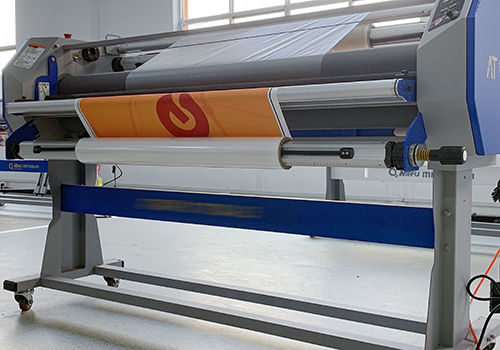
A vinyl laminator is a finishing machine used to apply a laminate film over printed vinyl or other graphic media. Depending on the machine and film system, lamination may use pressure-sensitive adhesive, heat-assisted pressure, or heat-activated film.
The purpose of the equipment is more than simply bringing two layers together. A laminator needs to control pressure, media movement, alignment, and, where applicable, temperature so that the laminate contacts the printed surface consistently.
The machine configuration should therefore be matched to the material and the application. Flexible roll media, for example, is generally handled differently from rigid boards or mounted graphics.
Before choosing a machine, it is useful to understand the laminate itself, including its construction, finish, thickness, and adhesive system. For a broader overview, see our guide to Vinyl Lamination Film.
Start with the Application, Not the Machine
The best way to choose a vinyl laminator is to start with the work you need to produce.A machine that works well for continuous roll-to-roll vinyl graphics may not be the most practical option for large rigid boards. Likewise, a laminator designed for occasional production may not be the right fit for a business processing long rolls every day.
Four questions provide a useful starting point:
1.What type of material are you processing?
2.Is the media flexible or rigid?
3.What is the maximum size and thickness?
4.What production volume do you need?
Once these requirements are clear, it becomes much easier to narrow down the appropriate laminator configuration.
What Type of Material Are You Processing?
Start by identifying the materials that will regularly pass through the machine.
Common examples include:
· Printed self-adhesive vinyl
· Vehicle graphic films
· Banners
· Posters
· Flexible signage
· Mounted graphics
· PVC boards
· Acrylic panels
· Composite panels
· Other large-format print substrates
Material construction matters because different media can require different approaches to feeding, pressure, positioning, and support.A flexible vinyl roll may be efficiently processed through a roll laminator, while a large rigid panel is more naturally handled on a flat working surface.
Is Your Media Flexible or Rigid?
This is one of the most important equipment decisions.
Flexible Media
Typical flexible applications include:
· Printed vinyl
· Vehicle graphics
· Banners
· Posters
· Wall graphics
· Roll-to-roll signage
For these applications, a roll laminator is often the most direct choice because the material can be fed continuously through the rollers.
Rigid Media
Rigid applications may include:
· PVC foam board
· Acrylic
· Display boards
· Composite panels
· Mounted graphics
· Large-format signage
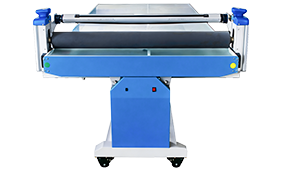
A flatbed applicator may be more appropriate where the material needs to remain supported on a stable work surface during application.MEFU's current flatbed applicator range is designed for both rigid and flexible media, with configurations intended for large-format signage and graphic mounting. Some configurations provide working areas up to 1600 × 3200 mm and support materials up to 50 mm thick.
What Size Are Your Graphics?
Working width should be based on the largest graphics you regularly process rather than the average job.
For example, if your production frequently involves 60-inch-class graphics, a laminator with a working width around 64 inches may be appropriate. MEFU's MF1700 series includes 1630 mm / 64-inch configurations, while the MF1600-B7 is listed at 1520 mm / 59 inches.
Also consider the physical space required for:
· Media loading
· Roll storage
· Operator access
· Front and rear operation
· Material unloading
A machine can meet your width requirement but still be poorly suited to the workflow if there is insufficient room to handle long graphics safely.
What Is Your Production Volume?
Production volume affects how much emphasis should be placed on speed, pressure control, automation, operator workflow, and machine capacity.
A business laminating a few graphics a week may prioritize simplicity and investment level. A commercial print operation processing multiple long rolls every day may place more value on production speed, repeatability, and workflow integration.
Do not evaluate speed in isolation, however. The useful production speed for a particular job depends on the film, print, substrate, adhesive system, operator workflow, and required finish.
Choose a Vinyl Laminator Based on Your Application
Once the basic production requirements are defined, the application itself can guide the equipment choice.
Printed Vinyl and Roll-to-Roll Graphics
For printed vinyl supplied in rolls, a roll laminator is often the most suitable starting point.
Roll laminators are designed to feed flexible media between rollers while applying consistent contact pressure. This makes them well suited to continuous processing of:
· Printed vinyl graphics
· Posters
· Banners
· Decals
· Wall graphics
· Wide-format digital prints
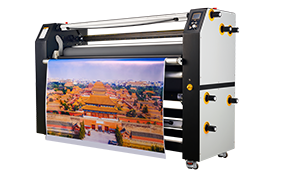
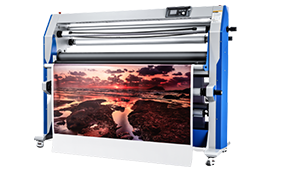
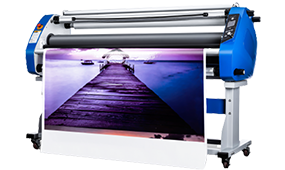
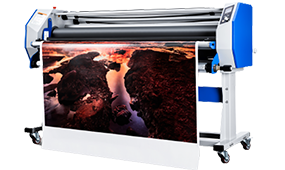
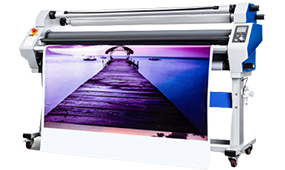
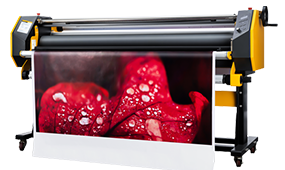
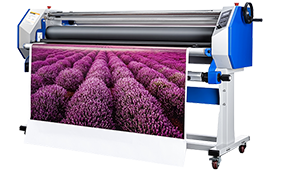
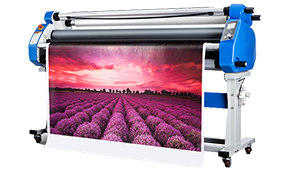
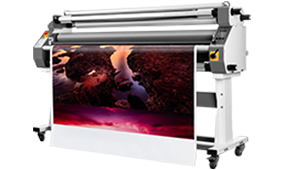
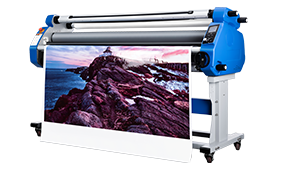
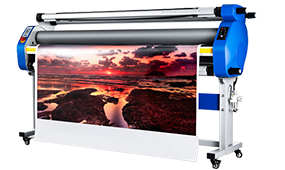
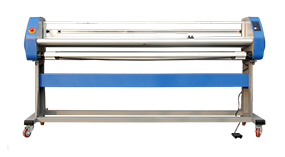
MEFU roll laminators cover a range of configurations for hot and cold or heat-assisted lamination. Its MF1700 series, for example, includes models with working widths up to 1630 mm / 64 inches and different combinations of heating, pressure adjustment, roller systems, and operating speeds.
For a print shop primarily handling flexible roll media, the main question is usually not whether a roll laminator can laminate vinyl, but which configuration best matches the shop's media, workload, and finishing requirements.
Vehicle Wraps and Automotive Graphics
Vehicle graphics place particular demands on flexible media handling. The machine needs to work with wide graphics while maintaining controlled contact between the laminate and printed vinyl.
Important considerations include:
· Working width
· Roller pressure
· Material alignment
· Media feeding
· Operator access
· Processing speed
A wide-format roll laminator can be a practical choice for businesses that regularly process vehicle graphics and other flexible materials.
The laminate film itself also matters. Compatibility between the printed vinyl and laminate should be evaluated alongside the laminator and application process rather than treating the machine and film as separate decisions.
Signage and Large-Format Printing
Sign production can involve both flexible and rigid media, so there is no single equipment configuration that is best for every sign shop.
For flexible signs, banners, and roll-fed printed graphics, a roll laminator is often appropriate.
For rigid signs and mounted graphics, a flatbed applicator can provide a more suitable working environment because the material can be positioned and supported on a table during application.
This is why a business that produces a broad range of signage may need to consider both equipment architectures rather than selecting a machine based only on the word "vinyl."
Rigid Boards and Mounted Graphics
When the task involves applying printed graphics or laminate to a rigid substrate, material positioning becomes especially important.
A flatbed applicator provides a stable horizontal work surface for applications involving materials such as:
· PVC boards
· Acrylic
· Foam boards
· Composite panels
· Display panels
MEFU's flatbed solutions include illuminated work tables, silicone pressure rollers, optional heating systems, and pneumatic systems on selected configurations. These features are designed around large-format graphic application and mounting workflows rather than conventional roll-to-roll production.
For businesses that frequently mount graphics as well as laminate flexible media, this additional capability can be an important equipment-selection factor.
Display and Exhibition Graphics
Display production often combines printing, lamination, mounting, trimming, and final assembly.
The appropriate laminator depends on the final format.
Flexible graphics may be processed using a roll laminator before trimming and installation. Graphics that need to be mounted onto rigid display materials may be better suited to a flatbed workflow.
Thinking about the entire finishing process helps avoid choosing a machine that works for one individual step but creates bottlenecks elsewhere.
.jpg)
.jpg)
Roll Laminator vs. Flatbed Applicator
Roll laminators and flatbed applicators can both be used in professional graphics production, but they are optimized for different workflows.
| Requirement |
Roll Laminator |
Flatbed Applicator |
| Flexible vinyl rolls |
Strong fit |
Suitable for selected applications |
| Roll-to-roll production |
Strong fit |
Not the primary workflow |
| Vehicle graphics |
Strong fit |
Application dependent |
| Posters and banners |
Strong fit |
Application dependent |
| Rigid boards |
Machine dependent |
Strong fit |
| Graphic mounting |
Limited by configuration |
Strong fit |
| Large display panels |
Material dependent |
Strong fit |
| Mixed rigid/flexible work |
Depends on model |
Strong fit on suitable configurations |
This comparison should be treated as a general equipment-selection framework rather than an absolute rule. Machine configuration matters. Some roll laminators include mounting or encapsulating functions, while some flatbed applicators can process flexible media.
The key distinction is the production workflow:
Roll laminator: primarily optimized for flexible media and continuous roll processing.
Flatbed applicator: primarily optimized for large-format application, rigid substrates, and graphic mounting.
Key Features to Consider When Choosing a Vinyl Laminator
Once the machine type is narrowed down, evaluate the technical features that affect actual production.
Maximum Working Width
The working width should match the widest graphics you regularly produce.
MEFU's MF1700 series includes 1630 mm / 64-inch configurations, making that class of machine suitable for many wide-format graphics workflows.
When choosing width, consider both today's production and the types of jobs you expect to add in the future.
Roller Diameter and Pressure
The roller system determines how the laminate contacts the graphic.
Pressure must be sufficient for the adhesive system and material combination, but "more pressure" is not automatically better. Excessive pressure can affect sensitive materials, while insufficient pressure can contribute to poor contact and adhesion.
MEFU uses silicon rollers across its roll laminator range, with examples including 120 mm, 130 mm, and 150 mm diameter configurations depending on the model.
Roller size should therefore be evaluated as part of the complete machine design rather than as an isolated specification.
Manual or Pneumatic Pressure Control
Pressure adjustment can be manual or pneumatic depending on machine configuration.
For straightforward applications, manual lifting and adjustment may be sufficient. For more demanding production environments, pneumatic systems can provide a more controlled approach to roller positioning and pressure application.
MEFU's current range includes hand-crank and pneumatic roller-lifting configurations. Its MF1700-F1, for example, uses a hand-crank lifting system, while higher-specification MF1700 configurations use pneumatic lifting.
When comparing machines, consider not only the pressure mechanism but also how easily operators can repeat the desired setup.
Cold or Heat-Assisted Lamination
The choice between cold and heat-assisted lamination should be based on the laminate film and adhesive system.
Pressure-sensitive adhesive films can often be applied without high processing temperatures. Low-temperature heat assistance may also be used with certain PSA systems to improve adhesive wet-out and application performance.
MEFU's documentation describes low-heating cold lamination in the approximately 40–50°C range and hot lamination configurations reaching higher temperatures, depending on the machine and film system.
The correct setting always depends on the specific laminate and media. Temperature should therefore be selected according to the material manufacturer's recommendations rather than treated as a universal machine setting.
Material Thickness Capacity
Thickness is particularly important when working with rigid or mounted materials.
A laminator's stated maximum thickness is a machine specification, but usable thickness also depends on the material construction and the application.
For example, MEFU lists maximum lamination thickness values such as 23 mm or 28 mm on different MF1700 configurations, while selected flatbed applicators support substrates up to 50 mm thick.
When reviewing specifications, make sure you distinguish between:
· Maximum machine capacity
· Your normal production thickness
· The actual combination of substrate and laminate
Material Alignment and Handling
Large-format graphics can be difficult to manage if alignment and feeding are inconsistent.
For roll-fed applications, consider how the machine handles:
· Roll loading
· Material tension
· Feeding
· Alignment
· Operator access
For flatbed applications, consider:
· Table size
· Material positioning
· Roller movement
· Substrate support
· Operator access
Material handling is especially important for large graphics because a technically capable machine can still be inefficient if loading and positioning consume excessive operator time.
Operating Speed
Machine speed should be considered together with lamination quality.
MEFU's current MF1700-C3 is listed with a maximum speed of 20 m/min, while the MF1700-F1 is listed at up to 12 m/min and the MF1700-F1 PLUS at up to 50 m/min.
These figures represent machine capabilities rather than a guaranteed production speed for every film and graphic.
The actual working speed can depend on temperature, pressure, adhesive behavior, material thickness, and the required finish. MEFU's technical guidance also notes the relationship between laminating speed and temperature, emphasizing that the two parameters should be considered together.
Choose a Vinyl Laminator Based on Production Requirements
Application determines the general machine type, while production requirements help determine the appropriate machine configuration.
Small Print Shops and Sign Businesses
For occasional or lower-volume production, simplicity can be an important consideration.
A suitable machine may need to provide:
· The required working width
· Straightforward controls
· Appropriate pressure adjustment
· Suitable cold or heat-assisted capability
· Easy media loading
MEFU's MF1700-M1 is positioned as an entry-level heat-assist laminator with a 1630 mm / 64-inch maximum lamination width, up to 9 m/min speed, and a 60°C maximum temperature. It uses hand-crank roller lifting on the standard configuration.
For businesses with relatively straightforward flexible-media work, this type of configuration may provide the required capability without unnecessary complexity.
Growing Production Environments
As production volume increases, operators typically place greater emphasis on repeatability, workflow efficiency, and easier machine adjustment.
A more capable configuration may provide:
· Pneumatic roller lifting
· Wider operating flexibility
· Digital speed and temperature controls
· Improved operator workflow
· Additional finishing functions
MEFU's MF1700-C3, for example, offers a 1630 mm / 64-inch working width, pneumatic lifting, 130 mm silicon rollers, top-heated warm lamination, and a maximum listed speed of 20 m/min.
High-Volume Professional Production
High-volume operations need to look beyond nominal speed.
The important questions become:
· Can the machine maintain a stable workflow over long production runs?
· Is material loading efficient?
· Can operators reproduce settings consistently?
· Does the machine provide the required pressure and temperature control?
· Can it integrate with cutting or other finishing stages?
MEFU's higher-end MF1700 configurations include pneumatic systems and expanded automation and monitoring features. The MF1700-F1 PLUS is listed with a maximum speed of 50 m/min, automatic stop and alarm functions, and a 150 mm silicon roller, while the MF1700-C3 is positioned as a professional machine for businesses seeking additional capacity and versatility.
For industrial production, machine selection should therefore be based on the complete workflow rather than a single headline specification.
Building a Complete Vinyl Finishing Workflow
A vinyl laminator rarely operates as an isolated piece of equipment.
A typical workflow may look like:
Printing → Drying or Curing → Inspection → Lamination → Mounting or Cutting → Final Installation
The exact sequence depends on the application.
Flexible Vinyl Workflow
For roll-based graphics:
Printing → Drying → Roll Lamination → Cutting → Installation
This workflow is common for products such as vehicle graphics, decals, banners, and other flexible printed graphics.
Rigid Graphics Workflow
For rigid applications:
Printing → Lamination → Graphic Mounting → Cutting or Finishing → Installation
Here, a flatbed applicator can become part of a broader mounting and finishing workflow.
Considering the complete production sequence can help prevent a common purchasing mistake: selecting equipment that performs one operation well but does not match the material handling requirements of the next operation.
How MEFU Supports Different Vinyl Lamination Applications
MEFU's finishing equipment portfolio is structured around different production formats and finishing requirements. Its current range includes roll laminators, flatbed applicators, precision cutting equipment, and related finishing solutions.
Roll Laminators for Flexible Graphics
For businesses primarily processing flexible vinyl and roll-to-roll graphics, MEFU's roll laminator range includes entry, premium, and professional configurations.
Depending on the model, features can include:
· 1520–1630 mm class working widths
· Silicon pressure rollers
· Manual or pneumatic lifting
· Cold or heat-assisted lamination
· Temperature and speed controls
· Additional trimming or finishing functions
The MF1700-M1 is positioned for entry-level heat-assisted PSA lamination, while the MF1700-C3 is designed for businesses seeking higher production capacity and versatility.
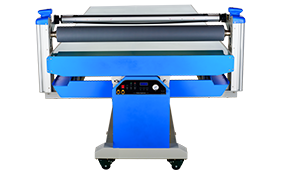
Flatbed Applicators for Rigid and Large-Format Work
For rigid boards, large-format graphics, and mounting applications, MEFU offers flatbed applicator configurations.
Selected systems include:
· Illuminated working tables
· Silicon pressure rollers
· Pneumatic lifting systems
· Optional heating
· Large working surfaces
· Support for rigid and flexible media
For example, MEFU Flatbed Applicator MF-B4 configuration is listed with a 1600 × 3200 mm working area and a maximum lamination thickness of 50 mm.
This type of equipment can be particularly useful when lamination is only one part of a larger graphic mounting and finishing process.
A Practical Checklist for Choosing a Vinyl Laminator
Before purchasing a vinyl laminator, review your actual production requirements.
Material
· What vinyl and laminate films do you use?
· Are your materials flexible, rigid, or both?
· What substrate thicknesses are common?
Application
· Vehicle graphics?
· Signage?
· Posters and banners?
· Wall graphics?
· Rigid displays?
· Graphic mounting?
Machine Size
· What is your widest regular job?
· Do you need a 54-inch, 60-inch, 64-inch, or larger working width?
· How much room is available around the machine?
Lamination Method
· Cold?
· Heat-assisted?
· Hot?
· Single-sided?
· Double-sided?
Pressure and Handling
· Manual or pneumatic lifting?
· What pressure-control method is appropriate?
· How will long or large graphics be aligned?
Production
· Occasional?
· Daily commercial production?
· High-volume continuous production?
Workflow
· Is lamination the only finishing operation?
· Do you also need mounting?
· Will the laminator need to work alongside cutting or other finishing equipment?
Answering these questions before comparing machine models can make equipment selection much more straightforward.
Frequently Asked Questions
What type of laminator is best for vinyl?
There is no single best laminator for every vinyl application. Roll laminators are generally suited to flexible roll media and continuous production, while flatbed applicators are better suited to rigid boards, large-format mounting, and applications requiring a stable flat working surface.
Can I use a regular laminator for vinyl?
It depends on the machine, vinyl, laminate film, and application method. The laminator should be designed to handle the relevant material width, thickness, adhesive system, and application pressure.
What is the best laminator for vehicle wraps?
For businesses primarily producing vehicle graphics, a wide-format roll laminator is often the most practical configuration because vehicle wrap materials are typically flexible and supplied in rolls. Working width, pressure control, alignment, and material handling should all be considered.
Do I need a cold laminator for vinyl?
Not necessarily. Many pressure-sensitive laminate films can be applied using cold lamination, while some workflows use low-temperature heat assistance or heat-activated films. The correct method depends on the film and adhesive construction.
MEFU offers roll laminator configurations for cold and heat-assisted applications, with temperature capabilities varying by model.
What is the difference between a roll laminator and a flatbed applicator?
A roll laminator is primarily designed to process flexible media through rollers, making it suitable for roll-to-roll graphics.
A flatbed applicator uses a working table and moving pressure roller to process large graphics and substrates, making it particularly useful for rigid boards and graphic mounting.
What size vinyl laminator do I need?
Choose a working width based on the widest graphics you regularly process. Also consider future production requirements, workspace, and how materials will be loaded and handled.
For example, MEFU offers 1630 mm / 64-inch roll laminator configurations within its MF1700 series.
Is a faster vinyl laminator always better?
No. Maximum speed is only one part of machine performance. Lamination quality also depends on pressure, temperature, adhesive behavior, material handling, and the specific film and substrate combination.
MEFU's technical guidance notes that speed and temperature are related during lamination, so operating parameters should be selected for the specific material and process rather than simply using the highest available speed.
Can one machine handle different vinyl lamination applications?
Some laminators provide greater versatility than others. A multifunctional roll laminator may support different film types and finishing functions, while a flatbed applicator can be more suitable when rigid substrates or graphic mounting are involved.
The key is to select the machine around your most important applications and then check whether its configuration covers your secondary requirements.
Conclusion
Choosing the right vinyl laminator starts with the application rather than the machine specification.For flexible roll-to-roll vinyl graphics, vehicle wraps, posters, and banners, a roll laminator is often the most suitable starting point. For rigid boards, mounted graphics, and large-format display work, a flatbed applicator may provide a more appropriate workflow.
From there, consider working width, material thickness, roller and pressure systems, cold or heat-assisted lamination, speed, material handling, and production volume.The goal is not simply to buy a laminator with the highest specification. It is to choose equipment that matches your materials, applications, operators, and production workflow.
For professional print and signage businesses, MEFU provides roll laminators and flatbed applicators for different graphic finishing requirements, allowing equipment selection to be based on the actual application rather than a one-size-fits-all approach.


 Premium Series